Designing Preferred Futures: From Prediction to Deliberate Design
We often speak about the future as though there were only one. But what if the future is plural? This article explores why societies and organisations inherit the probable future instead of deliberately designing a preferable one.
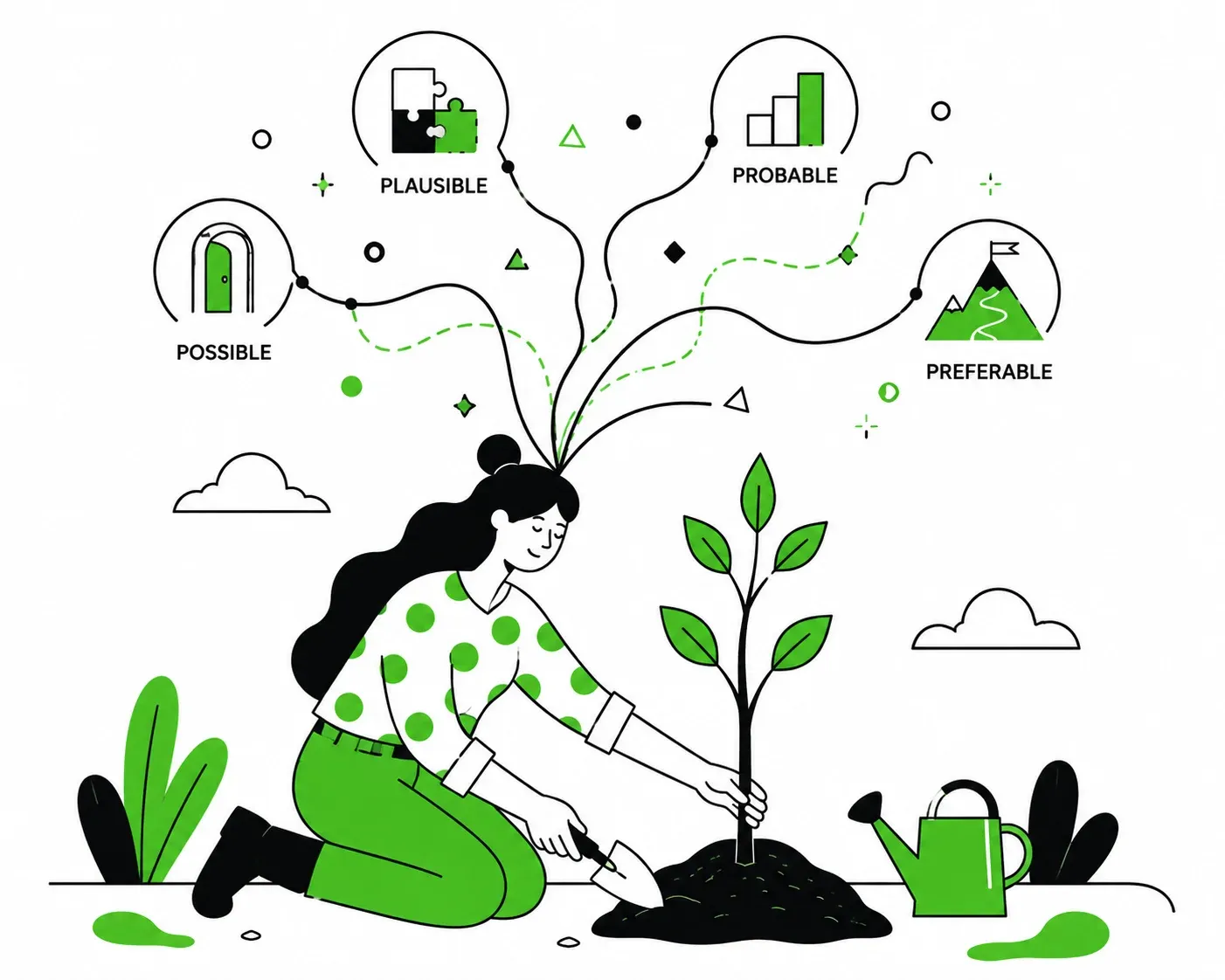
Today I want to talk about “futures”: in the plural, not the singular. That distinction, which may seem like a grammatical detail, is in fact where everything else begins. To explain why, I keep thinking about the image of a gardener planting a tree while imagining a forest that does not yet exist. Their hands are in today’s soil, but their gaze is fixed on a forest that can only grow from the present.
What the gardener does with a single tree, a collective does with its direction: a society changing government, an organisation changing course. Over the past few weeks, I began to notice a coincidence: transitions of government taking place in different parts of the world, almost at the same time. At such moments, the direction a country will take becomes open to debate once again. For a brief moment, the future ceases to be taken for granted and can once again be decided. When a future reopens like this, I find myself asking: who decides which of all the possible futures will come to pass?
The future is plural, there are many scenarios that may unfold depending on the decisions that are made, whether at the level of a country or an organisation: the possible, the plausible, the probable and the preferable. What is remarkable is that we almost always end up living (and deciding) as though it were not. As though there were only one future, already written, and our only task were to reach it. We mistake the probable for the inevitable. And once we accept that the future is plural, our way of thinking about it changes as well. It is no longer a question of reaching a future we assumed was fixed, but of acting today so that the future we prefer becomes possible. The first perspective lives in tomorrow; the second lives in the present.
So why do we so often inherit the probable future instead of choosing a better one? I believe the answer lies in a mismatch of rhythms. The changes that transform a society or an organisation, from technological advances to economic and social transformations, happen quickly, sometimes exponentially. But the institutions capable of channelling those changes move slowly, in a linear way. In that mismatch, while the rules struggle to catch up, the default future establishes itself through sheer inertia. Not because nothing changes, because the circumstances are constantly shifting, but because no one decides what to do with those changes until the rules themselves become open to revision once again.
We can see this with artificial intelligence. As new tools, models and ways of working continue to emerge, institutions are trying to understand their implications and translate them into rules. It is not that regulation does not exist; rather, technological change continues to advance while that regulation is still being developed, refined and tested. Circumstances have already changed several times over, yet the rules are still trying to catch up. History illustrates this vividly: during the late nineteenth century, in the so-called Gilded Age in the United States, rapid industrial growth gave rise to powerful monopolies and increasingly visible political corruption. Reforms did come, with the creation of a merit-based civil service and the first antitrust legislation, but only after decades of economic transformation and public pressure. So, institutional corrections do happen, but they usually arrive late; sometimes decades after the change has already reshaped reality.
What episodes like these show is that the possibility of redesigning the direction of a country or an organisation does not disappear once a government takes office or a leadership team is in place. It remains throughout the entire process; what changes is the cost of exercising it. A change of government or a change of leadership simply makes that possibility especially visible, because at those moments it feels natural to reconsider where we want to go. But the possibility already existed beforehand, and it will remain afterwards.
During a transition, what normally feels fixed, settled and inherited becomes malleable once again. A new government is expected to define the country's direction, usually through a national plan shaped by a particular vision of the future. A vision is the way in which a collective turns a preferable future into a shared direction. What we rarely acknowledge is that this possibility does not disappear once the transition is over. A government well into its term can also look at the course it originally set and decide that it is no longer the right one. That is more difficult, because it carries a cost that a transition does not: for those elected on a promise, it can feel as though the rules have changed halfway through the journey, yet the possibility remains, for anyone willing to pay that price.
Exactly the same applies to an organisation, only on a different scale. A change of leadership makes that freedom visible because it seems natural for those who arrive to redefine the organisation’s direction. Yet an organisation does not need to wait for a merger, a crisis or a new chief executive before asking itself where it is heading. Its vision, that preferable future that almost every organisation has written down somewhere, is not a fixed destination that is eventually reached and then exhausted. It is a direction, a lodestar that guides without ever being fully attained. The strategies that pursue it must continue to adapt along the way, and the vision itself may also change, because it is not the only way the future might unfold. It is one possibility among many, just as subject to the possible and the plausible as any other.
But reopening the future is not enough. Imagining alternative futures is not yet the same as designing them. There is a profound difference between allowing the probable future to unfold and deliberately building a preferable one. That future does not arrive on its own; it begins with the decisions we make today. Designing means reading the signals of the present, questioning our own assumptions and imagining different courses of action before deciding which deserves to become reality. It is a way of actively participating in the construction of what comes next, rather than merely reacting once change has already happened. Those who do this tend to adapt, reinvent themselves and endure; those who do not often realise too late that the future has already moved on without them. That is why the opportunity presented by a transition is not about predicting what comes next more accurately, it is about designing it.
There is something that has stayed with me after following this line of thought. We tend to speak about the future as though it were a place we will one day arrive at, when perhaps it is more accurate to think of it as a direction we build through the decisions we make as we move forward. We may not always be able to choose the circumstances we encounter, but we can choose which future we want to try to make possible, and we can keep revisiting that direction whenever reality requires us to do so.
So, I return to the gardener. They never know for certain whether the tree they plant today will one day become a forest. Nor can they control the weather, the passing of time or what lies ahead. The only thing they can decide is to plant the tree. And perhaps, in the end, that is what it means to design a future: not to wait and discover what it will be, but to participate deliberately in what it might still become.
If this article sparked a question or a different way of thinking, I'd love to hear it. You can write to me anonymously below. I read every submission, and many of them would inspire future articles.